How to Choose the Best Wire Rope Sling Supplier in China?
Choosing the best wire rope sling supplier in China requires more than comparing quoted prices. The global wire rope market is expanding across construction, ports, mining, energy, and lifting equipment. Grand View Research’s Wire Rope Market Size, Share & Trends Analysis Report, 2024–2030, identifies infrastructure investment and industrial lifting as important growth drivers. Fortune Business Insights also highlights construction and oil and gas as major demand sectors in its Wire Rope Market Report.
Demand is growing. So is supplier variety.
A reliable supplier should show practical manufacturing experience, not only polished product photographs. Ask for material certificates, breaking-load results, batch traceability, and inspection records. ISO 2408 provides internationally recognized requirements for steel wire ropes, while EN 13414 addresses steel wire rope slings. These references help buyers compare factories using consistent technical language. They also expose vague claims.
Look closely at the details. A competent factory should explain rope construction, sling diameter, eye protection, ferrule type, safety factor, and proof-test procedures. The answer should remain clear when specifications change. Packaging matters too. Galvanized slings arriving with crushed eyes or exposed strands reveal weak quality control. No brochure can hide that.
A supplier audit should include production footage, equipment checks, sample testing, and conversations with quality personnel. Independent laboratory verification adds confidence, especially for high-load applications. Still, no supplier evaluation is flawless. Documents may be outdated, and one excellent sample cannot represent every shipment. This guide therefore examines certification, testing, communication, customization, lead time, and after-sales support. The goal is not simply to find a cheap wire rope sling supplier. It is to find a transparent, technically capable, and consistently dependable partner.
Define Required Sling Specifications: WLL, Diameter, Length, and ASME B30.9
When choosing a wire rope sling supplier in China, define the required specifications before requesting quotations. Start with the working load limit (WLL), not only the rope’s breaking strength. WLL changes with sling type, hitch method, load angle, and end fittings. A vertical lift differs from a basket or choker hitch. State the required diameter and construction clearly. Include the sling length, measured eye to eye, and allow for connection space.
Tips: Send a simple lifting sketch with your inquiry. Show the load weight, lifting points, hitch style, and minimum bend radius. Ask the supplier to confirm WLL under your actual configuration. Request material details, inspection records, proof-test documents, and traceability markings. Vague certificates are a warning sign. Do not guess.
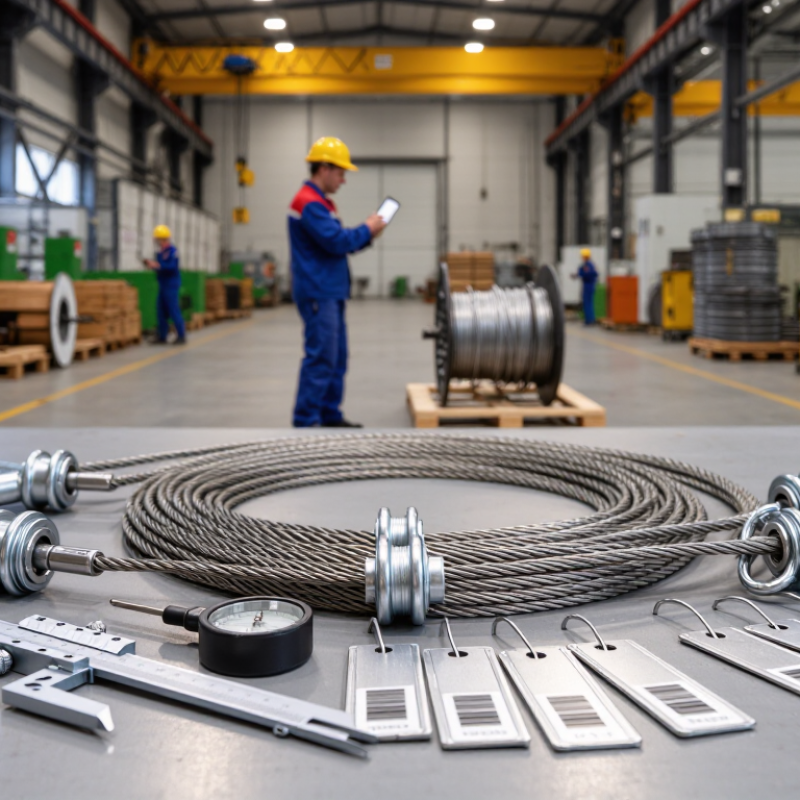
A reliable supplier should explain how the sling follows ASME B30.9 requirements. Check whether identification tags show WLL, diameter, length, construction, and inspection information. Ask how the supplier controls wire rope assembly, eye splicing, ferrules, and protective sleeves. Photos help, but they do not replace complete records. I have seen buyers focus on price and overlook sling length tolerance. That mistake can affect connection safety. Also review storage and inspection guidance. Even a correctly manufactured sling can be damaged by sharp edges, poor winding, or repeated overloading. Your specification may still be incomplete after one inquiry. Recheck it with the lifting supervisor.
Verify Safety Factors: Select Slings With a Minimum 5:1 Design Factor
When choosing a wire rope sling supplier in China, safety factors deserve more attention than a polished catalog. Select slings with a minimum 5:1 design factor. This means the sling’s minimum breaking strength should be at least five times its working load limit. Do not confuse this ratio with extra lifting capacity. The working load limit still controls every lift.
Ask the supplier for strength-test reports, material records, and clear identification tags. Each sling should show its rated capacity, length, rope construction, and inspection information. Check whether the test report matches the actual sling. A document with no batch number is difficult to trust. Request proof-load or destruction-test data from an independent laboratory when the application is critical. Small details matter.
Examine the hardware closely. Look for smooth eyes, properly secured terminations, and hooks without cracks or severe deformation. Ask how the supplier controls rope damage, corrosion, and improper bending during production. Experienced suppliers should explain sling angles, edge protection, and shock loading in practical terms. A 5:1 factor cannot correct careless handling. It is only a design margin.
I have seen purchasing teams focus on price and overlook inspection support. That approach feels efficient, but it can create expensive uncertainty later. Suppliers should provide inspection guidance and replacement criteria, not vague promises. If an answer sounds too simple, ask again. Safety decisions should be supported by traceable evidence, trained personnel, and conditions that match the intended lift.
Audit Supplier Quality: Check ISO 9001, Traceability, and Test Certificates
Choosing a wire rope sling supplier in China requires more than comparing prices. Start with an ISO 9001 certificate, but verify its scope, issuing body, expiry date, and manufacturing site. The ISO Survey 2022 recorded 1,265,216 ISO 9001 certificates across 189 countries and economies. That number shows quality certification is common, not automatically meaningful.
Ask for material traceability from steel batch to finished sling. Each sling should have a readable tag, rated capacity, rope diameter, construction, length, and production date. Request test certificates for breaking force, splicing, ferrules, and proof loading. The results should identify the tested sample and reference a recognized standard, such as EN 13414 or an equivalent national standard. A certificate without batch details is weak evidence. I have seen paperwork look complete while the physical tag remained unclear. That gap deserves attention.
Tips: Visit the factory, if possible. Compare the certificate address with the production address. Select three random slings and trace them backward to inspection records. Ask who signed the test report and which calibrated instrument was used. ISO 9001 does not prove every sling is safe; it indicates a controlled quality system. Supplier audits should also review calibration logs, nonconformity records, operator training, and corrective actions. Do not accept “tested” as enough. Require measurable results, consistent records, and clear answers. Mistakes happen, but unexplained mistakes should stop the purchase.
Compare Sling Capacity at Angles: A 60° Hitch Retains About 87% WLL
How to Choose the Best Wire Rope Sling Supplier in China?
A 60° hitch can retain about 87% of the sling’s vertical working load limit, according to common industry capacity tables. However, angle definitions differ between suppliers and standards. Confirm whether 60° means the choke angle, leg angle, or included angle. A small drawing prevents a costly misunderstanding.
ASME B30.9 requires sling identification, rated capacity information, inspection controls, and removal criteria. OSHA 1910.184 also requires employers to follow marked capacities and inspect slings before use. When comparing Chinese suppliers, request capacity tables based on recognized standards, not only a sales quotation. Ask for material certificates, proof-test records, wire-rope construction, core type, and traceability from rope batch to finished sling.
The difference appears on the hook. A 10-ton load may create sharply different leg tensions as the angle changes. A 60° configuration can look stable while increasing force at each eye and fitting. Check the actual geometry with a qualified lifting engineer. I would not trust a perfect spreadsheet alone. Field inspections may reveal crushed strands, broken wires, distorted thimbles, or heat marks that documents miss. The Wire Rope Technical Board’s Wire Rope Users Manual and ASME B30.9 provide useful technical reference points, but the supplier should explain how each rating was established. Ask for independent laboratory evidence when the lift is critical. Small details matter.
How to Choose the Best Wire Rope Sling Supplier in China? – Compare Sling Capacity at Angles: A 60° Hitch Retains About 87% WLL
The comparison below applies to a two-leg basket hitch with the included angle measured from the horizontal. The angle factor is calculated as 2 × sin(angle); therefore, a 60° basket hitch provides approximately 1.73 times the vertical-leg WLL, equal to about 86.6% of the theoretical maximum at 90°.
| Included Angle from Horizontal |
Angle Factor
2 × sin(angle) |
Capacity Compared with 90° Basket Hitch |
Example WLL per Vertical Leg |
Calculated Assembly WLL* |
Recommended Supplier Verification |
| 90° |
2.00 |
100.0% |
2.0 t |
4.00 t |
Confirm the rated capacity for the complete two-leg assembly. |
| 60° |
1.73 |
86.6% ≈ 87% |
2.0 t |
3.46 t |
Request angle-rated WLL tables and proof-test documentation. |
| 45° |
1.41 |
70.7% |
2.0 t |
2.83 t |
Check whether the supplier states the angle from horizontal or from vertical. |
| 30° |
1.00 |
50.0% |
2.0 t |
2.00 t |
Use a larger sling or a different lifting arrangement if the load requires more capacity. |
| 15° |
0.52 |
25.9% |
2.0 t |
1.04 t |
Avoid shallow angles unless the complete lifting plan confirms adequate capacity. |
|
*Calculation basis: Assembly WLL = WLL per vertical leg × 2 × sin(angle). The figures are theoretical angle calculations for a symmetrical two-leg basket hitch and do not replace the manufacturer's marked WLL. Actual capacity may be limited by the rope diameter, construction, end fittings, hitch configuration, bend diameter, connection hardware, edge contact, condition, and applicable lifting regulations. Do not use this table for choker hitches or for non-symmetrical loading.
|
Supplier-selection checks: Ask for permanent identification tags, traceability of wire rope and fittings, rated WLL charts, inspection criteria, proof-test records where required, and compliance with the applicable national or international lifting standard.