
A Tiny Electric Truck is more than a smaller pickup with a battery. It is a compact work vehicle designed for short trips, narrow streets, light cargo, and frequent stops. Its small footprint can fit beside a market stall, inside a warehouse yard, or along crowded urban lanes. That changes how we should judge it.
Rivian founder and electric-truck specialist RJ Scaringe once said, “We’re not trying to build an electric vehicle; we’re trying to build a great vehicle that happens to be electric.” This idea applies strongly here. A useful Tiny Electric Truck must carry tools, protect its battery, turn tightly, and remain simple to operate. Electricity alone does not guarantee good design.
Under the floor, a battery pack stores energy as direct current. An inverter sends controlled power to the electric motor. The motor then turns the wheels with immediate torque. During braking, regenerative systems can recover part of that energy. Many models use a single motor, while others add separate motors for improved traction.
The numbers need careful reading. A small battery may reduce weight, cost, and charging time. It may also limit range, payload, or performance on steep roads. Cold weather can reduce usable distance. Heavy cargo can expose the same weakness. That is not a failure, but it demands honest planning.
This article explores how these trucks work, where they perform well, and where expectations become unrealistic. The technology is promising. It is not magic.
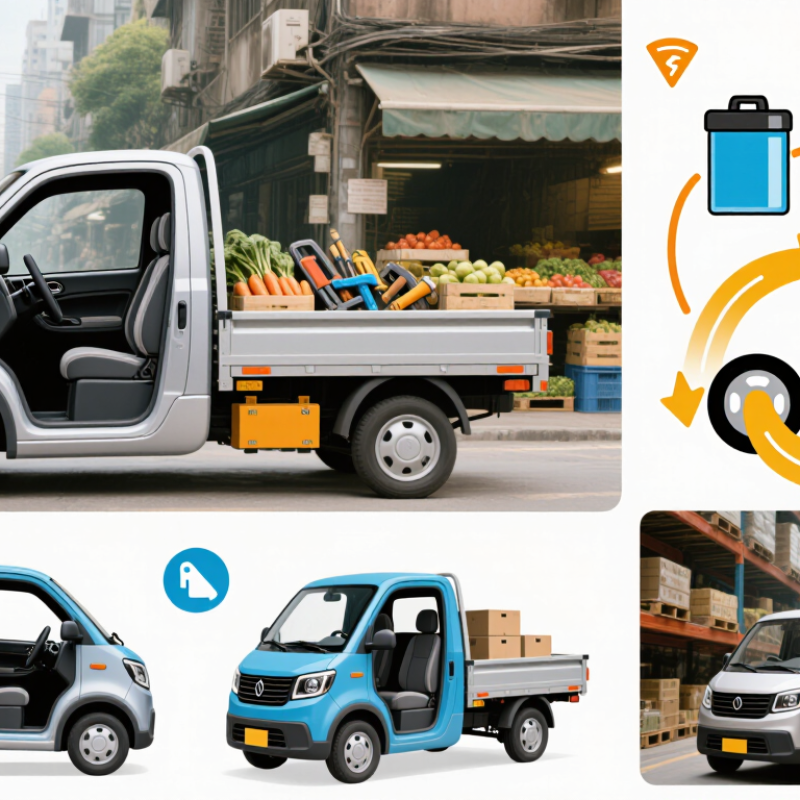
A tiny electric truck is defined less by one strict measurement than by its working purpose. It usually has a compact body, a low-speed electric powertrain, and enough cargo space for local tasks. Many models carry tools, parcels, produce, or maintenance equipment. Their batteries often support short daily routes rather than long highway journeys.
There is no universal global standard for “tiny electric truck.” This matters. Industry classifications differ by country and vehicle type. The International Energy Agency reported nearly 14 million electric car sales worldwide in 2023, showing rapid electrification. However, its data does not create a separate tiny-truck category. The U.S. Department of Energy also emphasizes battery capacity, charging behavior, payload, and duty cycle when evaluating electric vehicles. A practical definition should consider payload, wheelbase, turning radius, and operating speed. Appearance alone is misleading. A small-looking truck may lose useful range when heavily loaded or driven uphill.
Tips: Check the real payload, not only the advertised cargo volume. Measure your narrowest route. A 1,000-kilogram battery-powered vehicle may still be unsuitable for a 300-kilogram delivery task if charging access is poor. Slow charging can quietly disrupt a workday. I have also found that range estimates feel optimistic in cold weather, with frequent stops, or under full load. The better question is simple: Can the truck complete its routine, return safely, and recharge before tomorrow’s work?
A tiny electric truck is a compact utility vehicle powered by a battery, inverter, and electric motor. Its battery pack stores direct-current energy beneath the floor or behind the seats. The battery management system monitors temperature, voltage, and cell balance. This protection matters because heat can reduce battery life and charging safety. The inverter changes battery power into controlled alternating current for the motor. The motor then turns the axle through a simple reduction gear. Fewer moving parts can mean less routine maintenance, although suspension and brakes still wear.
The U.S. Department of Energy reports that electric drivetrains can convert about 60–70% of grid energy into wheel movement, compared with roughly 20–30% for gasoline vehicles. The IEA’s Global EV Outlook 2024 also recorded almost 14 million electric car sales in 2023, showing stronger demand for electric platforms. However, tiny trucks face a difficult trade-off. A larger battery improves range but reduces payload capacity. A stronger motor helps on steep roads, yet it consumes more energy. The label “tiny” can be misleading.
Tips: Check the battery’s usable capacity, not only its advertised size. Inspect payload ratings, charging time, ground clearance, and thermal controls. A basic payload test with tools or water containers can reveal weaknesses quickly. Do not trust range figures without considering cold weather, hills, and heavy loads. The real-world result may be less impressive. DOE testing data also shows that energy efficiency varies with speed and driving conditions, so careful operation remains important.
A tiny electric truck moves through a carefully controlled flow of electrical energy. Its battery stores direct current, while an inverter changes that energy into a form the traction motor can use. Pressing the accelerator sends a signal to the control system, not a mechanical cable. The controller then adjusts current and motor speed within milliseconds.
The motor creates strong torque from a standstill. This helps the truck pull away with a heavy load, even without a traditional multi-speed gearbox. A reduction gear lowers motor speed and increases turning force at the wheels. The differential then distributes that force between the tires. Small trucks often feel quiet and immediate. The silence can hide how much work the motor is doing.
Energy can flow backward during deceleration. The motor acts like a generator and sends some motion back to the battery. This process, called regenerative braking, reduces friction-brake use. It is not perfect. A cold, nearly full, or overheated battery may accept less recovered energy. Payload, tire pressure, hills, and weather also change real-world range. A practical check involves driving the same route with an empty bed and then a loaded one. The difference can be surprisingly large. Charging reverses the process, moving electricity through onboard protection systems before the battery stores it. Safety sensors watch temperature, voltage, and current throughout the cycle.
This representative chart starts with 100 units of energy from the battery. Typical conversion losses occur in the power electronics, electric motor, and mechanical drivetrain, leaving about 82 units available at the wheels.
A tiny electric truck uses a rechargeable battery and electric motor to move a compact cargo bed. Its small size can help in tight streets, farms, and work yards. Charging time depends on battery size, charger power, temperature, and the truck’s charging limits. The U.S. Department of Energy’s Alternative Fuels Data Center notes that Level 2 charging commonly adds about 10–20 miles of range per hour. That is useful overnight, but less convenient between short jobs. DC fast charging can be quicker, though not every small truck supports it. Real use is messier.
Range figures are estimates, not promises. Heavy loads, cold weather, hills, and repeated stops can reduce distance between charges. A useful comparison is the expected daily route, with a buffer for detours and heating or cooling. Payload also needs careful checking. It is generally the truck’s gross vehicle weight rating minus its curb weight, so passengers and accessories can reduce available cargo capacity. A pallet may fit physically yet exceed the rated payload. That distinction is easy to miss.
Tips: Charge overnight when possible, and check the truck’s manual for compatible charging rates. Weigh typical cargo, including tools and passengers, rather than relying on bed volume. Keep a route log for a week; your real range may differ from the brochure. That’s worth admitting.
A tiny electric truck is a compact work vehicle powered by a battery, electric motor, and electronic controller. Pressing the accelerator sends stored battery energy to the motor. Regenerative braking then returns part of the motion energy to the battery. The IEA’s Global EV Outlook 2024 reports nearly 14 million electric cars were sold worldwide in 2023. Tiny trucks remain a smaller niche, but this wider shift supports improving batteries, chargers, and service skills.
Their common uses are practical. A property worker can carry tools across a campus, while a farm operator can move feed, bins, or harvested vegetables short distances. They also suit warehouses, resorts, airports, and municipal maintenance routes. The U.S. Department of Energy identifies low-speed electric vehicles as useful for short, predictable trips. Quiet operation helps near hospitals and residential areas. Zero tailpipe emissions matter indoors, although electricity generation still creates emissions.
The benefits are clear, but not unlimited. Electric motors provide immediate torque and require fewer routine powertrain services. A small truck can also fit narrow paths and reduce parking pressure. Yet payload, range, charging time, and hill performance remain compromises. Cold weather may reduce usable range. Heavy loads expose this quickly. A 2024 International Council on Clean Transportation report links vehicle efficiency closely with battery size and energy consumption. Buyers should measure daily routes, not rely on optimistic range labels. Tiny does not mean effortless. Some operators may also underestimate tire wear, battery replacement costs, or the need for trained maintenance.
| Dimension | How It Works or What It Means | Common Uses | Benefits | Limitations |
|---|---|---|---|---|
| Basic definition | A tiny electric truck is a compact, battery-powered work vehicle with a cab and a cargo bed or utility body. The term is descriptive, not one universal vehicle class, so size, equipment, and legal classification vary. | Short-distance transport of tools, supplies, produce, waste, or light cargo. | Its small footprint can make it easier to maneuver and park than a full-size truck. | “Tiny electric truck” alone does not specify road legality, payload, crash protection, or performance. |
| Electric drivetrain | A rechargeable battery supplies electricity to a motor through power electronics. The motor turns the wheels, commonly through a simple reduction gear or drivetrain. | Frequent stop-and-go work around campuses, facilities, farms, and other defined sites. | Electric motors provide propulsion without tailpipe emissions and are generally quiet during operation. | Overall environmental impact depends on electricity generation, battery production, and vehicle use. |
| Battery and charging | The battery stores energy for driving and onboard equipment. Charging time depends on battery capacity, charger power, charging conditions, and the vehicle’s charging system. | Vehicles that return to a depot or workplace can often be charged between shifts or overnight. | Charging at a regular work location can reduce visits to fuel stations. | Charging requires access to suitable electrical supply; downtime and cold or hot conditions can affect operations. |
| Controls and energy use | A controller regulates power from the battery to the motor in response to driver input. Some vehicles also use regenerative braking to recover a portion of energy while slowing. | Low-speed routes with repeated stops, where controlled acceleration and braking are useful. | Fewer conventional engine-related service needs may reduce routine maintenance tasks. | Regenerative braking is not available on every model and does not recover all braking energy. |
| Cargo capacity | Payload and bed volume are set by the vehicle’s design. The rated payload includes cargo and may also be affected by passengers, accessories, and other loads. | Moving smaller loads, equipment, and supplies over short routes. | A purpose-built bed can make loading and unloading work materials convenient. | Payload and cargo space are usually more limited than those of larger work trucks. Loads must stay within the vehicle’s ratings. |
| Typical operating range | Range varies with battery size, load, speed, terrain, temperature, driving style, and use of heating or other accessories. | Predictable local routes where daily distance and charging opportunities can be planned. | Regular routes make it easier to estimate energy needs and schedule charging. | Published range is not a guarantee of real-world range; long trips or heavy loads may require careful planning. |
| Common work settings | Compact electric utility trucks are used in some controlled or local environments, depending on their design and legal approval. | Large properties, warehouses, campuses, resorts, farms, municipal facilities, and neighborhood-scale services. | They can suit repeated short trips where compact size and low-noise operation are useful. | They may not suit highway travel, long-distance hauling, steep routes, or heavy-duty work. |
| Road use and safety | Road access depends on the vehicle’s certification, equipment, registration, and the laws in the place where it is driven. Some compact electric vehicles are designed for restricted-speed use; others may meet different vehicle standards. | Private sites or public roads where the specific vehicle is permitted. | Choosing a vehicle suited to the route and work can support practical local transport. | Do not assume a small electric truck is street-legal or suitable for every road. Check local rules and vehicle documentation. |
| Best-fit decision | Compare the rated payload, usable range, charging setup, route conditions, safety equipment, and legal classification with the intended task. | Operations with modest loads, short distances, and reliable access to charging. | A close match between vehicle capability and daily work can make the vehicle efficient for its role. | A poor match may lead to insufficient range, overloading, charging delays, or restrictions on where it can operate. |
Specifications and legal requirements vary by vehicle and location. Check the manufacturer’s documentation and applicable local regulations before purchase or road use.


